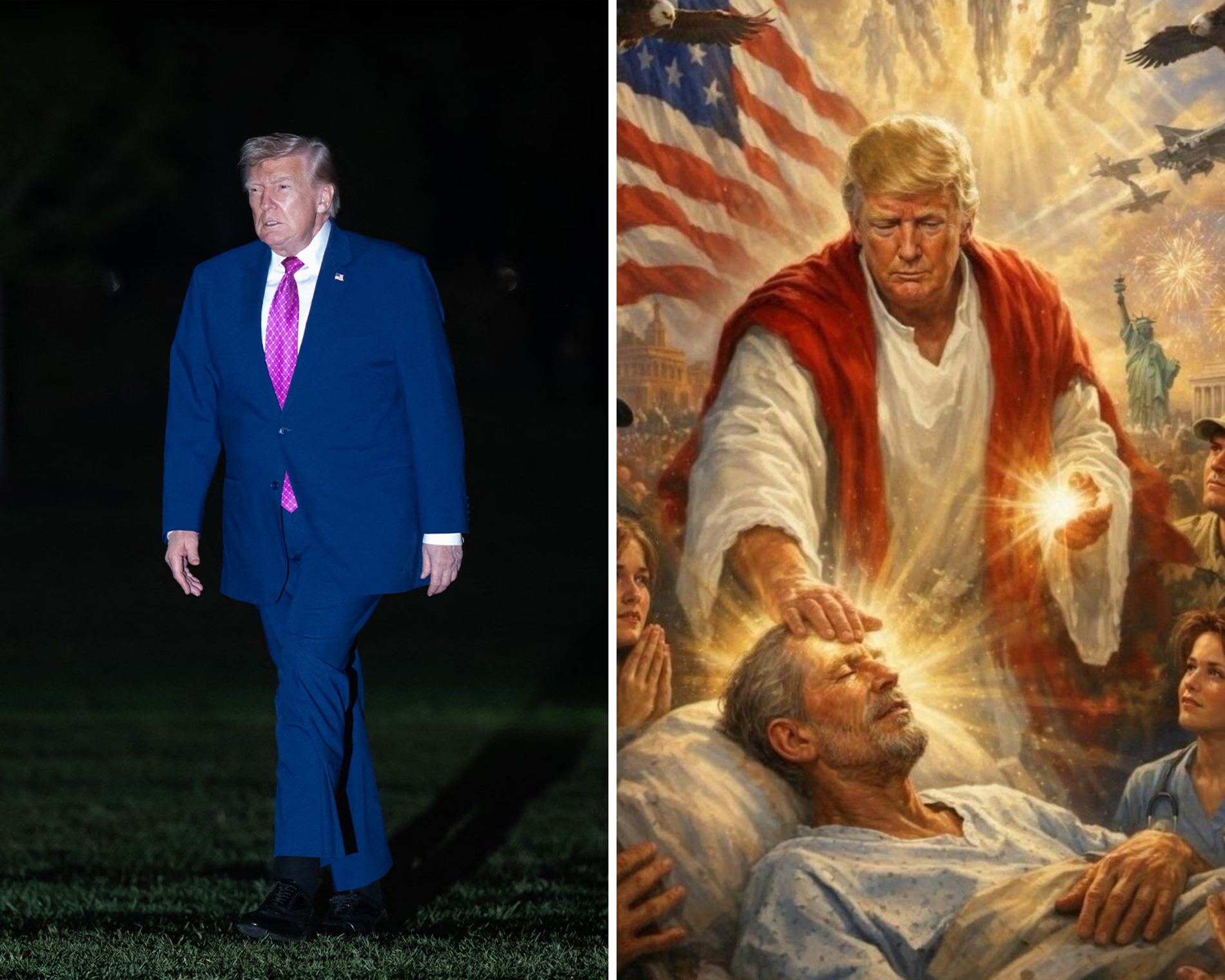
257. Donald Trump’s wild imagination
Yesterday, US President Donald Trump posted an AI-generated image of himself as a Jesus-like figure, appearing to “cure” a man. He deleted it after backlash from some of his religious supporters, but the damage is done. This incident is not unprecedented; Trump’s imagination often exceeds what most would consider reasonable.
I tried to conduct a psychological analysis of the mood he was in when he posted it, thinking of himself as Jesus, and immediately identified his ongoing tussle with the Pope as the reason.
He believes the Pope got his job because of him, so he is certainly above the Pope in stature. Which is, as a Catholic, only Jesus. So, he tried to assert his superiority. I forgive Trump for this act because he is addicted to seeing himself as superior to everyone.
Otherwise, he wouldn’t have said that: “Pope Leo is WEAK on Crime, and terrible for Foreign Policy. I don’t want a Pope who thinks it’s OK for Iran to have a nuclear weapon. I don’t want a Pope who thinks it’s terrible that America attacked Venezuela, a Country that was sending massive amounts of Drugs into the United States. I don’t want a Pope who criticizes the President of the United States because I’m doing exactly what I was elected, IN A LANDSLIDE, to do.”
He further added: “Pope Leo was an American, and they thought that would be the best way to deal with President Donald J Trump. If I wasn’t in the White House, Leo wouldn’t be in the Vatican. Leo should get his act together as Pope, use Common Sense, and stop catering to the Radical Left. It’s hurting him very badly and, more importantly, it’s hurting the Catholic Church! I don’t think he’s doing a very good job. He likes crime, I guess. He’s a very liberal person.”
The US vice-president, JD Vance, was quick to support Trump: “In some cases, it would be best for the Vatican to stick to matters of morality … and let the president of the United States stick to dictating American public policy.”
If we chronologize the events, the series began when US defense secretary Pete Hegseth urged Americans to pray for victory in the name of Jesus Christ and pray for “overwhelming violence of action against those who deserve no mercy.”
Pope remarked that God does not listen to the prayers of those who wage war, but rejects them. He also cited an Old Testament passage from Isaiah, saying, “Even though you make many prayers, I will not listen – your hands are full of blood.”
The second statement from Pope came after Trump warned of mass strikes against Iranian power plants and other infrastructure and said, “an entire civilization will die tonight.” Leo described such sentiments as “truly unacceptable.” He suggested that a “delusion of omnipotence” was fueling the US-Israeli war in Iran.
Trump’s remarks have been widely criticized. Iranian President Masoud Pezeshkian said: “On behalf of the great nation of Iran, I condemn the insult to Your Excellency and declare that the desecration of Jesus (peace be upon him), the prophet of peace and brotherhood, is unacceptable to any free person.”
Italy’s prime minister, Giorgia Meloni, said Trump’s words were “unacceptable,” but that was only after she came under pressure from the opposition.
However, Pope Leo's actions were not unprecedented. The Vatican has long promoted peace and issued messages of harmony, but no president has ever responded in such a stinging manner. As a symbol of peace and a spiritual guide for billions of Catholics, Pope Leo has every right to advocate for peace and to denounce all forms of war.
He has to act as a bridge builder, unlike Trump, who is a destroyer of relationships and civilizations.
Pope Leo said he did not fear the Trump administration, would continue to speak out against war, and did not want to enter into a debate with Trump. Good decision.
But before I conclude, I would like to share the remarks of bishops who were not silent.
On March 10, 2026, Pope Leo XIV called for an end to the U.S.-Israel war in Iran, and his bishops followed.
The Vatican secretary of state, Cardinal Pietro Parolin: “If states were to be recognized as having a right to ‘preventive war,’ according to their own criteria and without a supranational legal framework, the whole world would risk being set ablaze.”
Cardinal Robert McElroy, the archbishop of Washington, said the United States and Israel had failed to meet the minimum criteria for the war to be considered morally just. Such criteria would have included that it was a response to an imminent threat, that the U.S. and Israel had clearly articulated their intentions, or that the benefits would outweigh the harm. Lebanon may descend into civil war. The world’s oil supply is under great strain. The potential disintegration of Iran could produce new and dangerous realities. And the possibility of immense casualties on all sides is real. For all of these reasons, Catholic teaching leads to the conclusion that our entry into this war was not morally legitimate.
Cardinal Blase Cupich, the archbishop of Chicago, said, “A real war with real death and real suffering being treated like it’s a video game — it’s sickening. Our government is treating the suffering of the Iranian people as a backdrop for our own entertainment, as if it’s just another piece of content to be swiped through while we’re waiting in line at the grocery store.”
The Filipino Cardinal Pablo Virgilio David: “From distant command centers, military operators stare at screens where maps, radar signals, and algorithm-generated targets move like icons in a computer game. A cursor moves. A coordinate is selected. A click is made. And a missile is launched.”
I think war is always a last resort, must be undertaken only to correct a serious wrong, and requires right intent to achieve peace.
Here, the intent was poisonous.