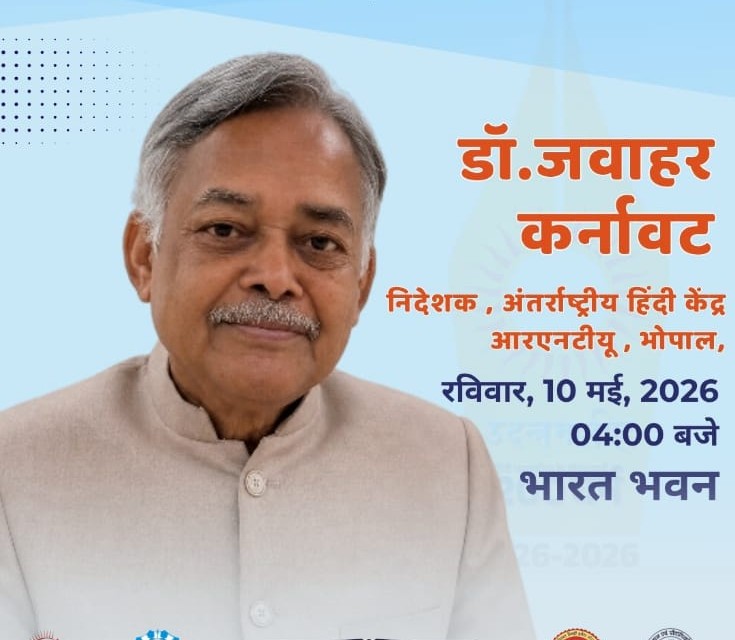
283. Dr Jawahar Karnavat – a man who will live as long as the language survives
It's rare to come across such individuals nowadays. Usually, you meet them only after they've reached major life milestones and are receiving a stable government pension.
Nonetheless, Dr. Jawahar Karnavat was still a banker at Bank of Baroda when I first met him in 2017. I consider myself fortunate to know him well, as we share a passion for literature.
Dr. Jawahar Karnavat was a busy man during those days, holding a high position in the bank’s management with numerous responsibilities.
The heavy workload from the merger of three banks (Dena Bank and Vijaya Bank merged with Bank of Baroda) would have exhausted anyone else, but meeting Dr. Karnavat was a completely different experience.
Besides his usual official duties, he maintained his passion for collecting rare Hindi magazines and newspapers published anywhere in the world.
He pursued this passion by any means possible. This has been his passion for the last two decades.
It was, in fact, an offshoot of his exploration of the history of Hindi journalism outside India over the last 20 years. His magnum opus, titled Videsho Mein Hindi Patrakarita, has now been published by the National Book Trust, offering a detailed account of Hindi journalism abroad.
His passion for research in this area has taken him to many countries across Asia, Africa, North America, Europe, and Australia.
The book documents over 150 Hindi journals published in the past 120 years from nearly 27 countries. He possesses most of the published issues of these journals.
And he is likely not satisfied with just finding one copy to add to his collection. Instead, he strives to find all existing copies of that particular magazine.
As a result, he has accumulated a large number of Hindi-language magazines and newspapers—almost unheard of and unseen, even among research scholars—published outside India.
But it was not an easy task. It took years of patience and travel, not to mention the investment of time, energy, and money—all because of his love for literature, especially his passion for Hindi and its growth.
I’m sure many of his colleagues probably called him a man of impulsive passion.
But that’s a price one has to pay when pursuing something they truly want to achieve.
The most notable aspect of the book is its celebration of Hindi publications outside India. Divided into four sections, each covering one continent, with a total of 22 chapters.
It extensively covers nearly the entire globe. Each chapter discusses the evolution of Hindi in that country, the founders and editors of the publications, their struggles, and the reactions they encountered.
The book emphasizes the challenges they faced and recognizes the many distinguished individuals and editors who undertook this demanding task.
It is not a book but a document that will be remembered by future generations.
Dr. Karnavat deserves all the praise for taking on this enormous task and executing it excellently.
He vividly recalls that it was 2001 when a rare magazine, well-documented in the history of India's freedom struggle, came into his possession.
An overjoyed Dr. Karnavat fell head over heels in love with it, and his fascination with the Hindi language and literature gradually led him to collect as many magazines as he could find.
His interests took him to various continents—some through his official engagements and many trips he funded himself.
He has visited some of the world's most renowned national libraries, documentation centers, and other institutions.
In a short time, he managed to connect with several people across the continent who eagerly offered to assist him. Such efforts are rare.
I have explored some of his rare possessions, and it has always been an eye-opening experience.
His collection includes Hindi newspapers and magazines published in Nepal, Japan, the UAE, Sri Lanka, China, Singapore, Kuwait, Pakistan, Mauritius, South Africa, Great Britain, Norway, Holland, Hungary, Germany, Russia, the USA, Canada, Trinidad, Tobago, Suriname, Fiji, New Zealand, and Australia.
All were published between 1903 and 2018. In total, his collection includes around 25 weekly, 3 fortnightly, 40 monthly, 18 quarterly, and 7 semi-annual magazines, covering the past 120 years.
The most titles come from Mauritius, Fiji, the USA, and the UK, with 15, 10, 8, and 7 titles, respectively. Additionally, there are six magazines from Australia, five from New Zealand, four each from Japan and Nepal, three each from South Africa, Norway, and Suriname, two each from Russia, Singapore, Canada, and Trinidad, and one each from Germany, Hungary, the UAE, Kuwait, Sri Lanka, Holland, and China.
This list does not include various special issues published to commemorate historical events.
His collection features numerous rare historical newspapers and magazines. The oldest is Indian Opinion, published in 1903 in South Africa in Gujarati, Tamil, English, and Hindi.
Its significance in world politics is well recognized, as evidenced by Mahatma Gandhi's publication. The Diwali special issue of Shanti Doot, published in Fiji, contains as many as 120 pages.
There are a few handwritten bulletins. These single-copy magazines were circulated by their editors. After reading, each copy was passed to another person, and ultimately the copy was returned to the editor,” Dr. Karnavat explains
. The handwritten magazine Durga, released in 1935 in Mauritius, serves as an example. Dina Patrika was also a handwritten magazine published in Hungary.
Shantidoot newspaper, published in Fiji in 1935, and Jwalamukhi, published in Japan, are notable examples.
Tasviri Akhbar, published in Britain in 1913, featured only pictures with short captions.
As news of Dr. Karnavat’s rare achievement spread, he received invitations from numerous literary and social organizations and institutions.
They invited him to showcase his collection not only across various cities in India but also internationally. Over time, this has become a regular feature at Hindi conferences worldwide.
The Ministry of External Affairs of the Government of India specifically invited him to present his collection at the 2018 World Hindi Conference in Mauritius.
He participated as part of the Indian government delegation, attending alongside Kiren Rijiju, the Union Minister of State for Home Affairs, and Shri Keshari Nath Tripathi and Mrs. Mridula Sinha, the governors of West Bengal and Goa, respectively.
The list of such invitations and recognitions is extensive.
Now, the constant applause and appreciation have become a part of Dr. Karnavat’s life. A special program showcasing his rare collection was produced and broadcast by Lok Sabha TV. Even the Limca Book of World Records has expressed interest in including this achievement.
After all, this is a unique endeavor, and perhaps no other individual in the world has accomplished this on a personal level.
Dr. Karnavat has been receiving offers from well-known libraries and institutions to showcase his collection for future generations.
An institution in Bhopal has offered to create “Dr. Jawahar Karnavat’s Corner” at its prestigious complex to display the collection. However, his journey is still ongoing.
Lovingly called Doctor Saab by his many friends, he has definitely made us proud. I personally enjoy listening to his journey in his gentle voice, as he describes all the obstacles he faced, recognizes individuals, and highlights their contributions that helped him complete this historic project.
Hindi lovers around the world will celebrate Dr. Jawahar Karnavat’s contribution as long as the language survives.