217. Rajya Sabha & A shameless addiction to power
Do we really need the Rajya Sabha? The answer is a definite NO.
The first of the many reasons is that it has become a sanctuary for the shameless addict of power.
After serving as prime minister for 10 years, Manmohan Singh remained a member, though he was wheelchair-bound and never attended the proceedings. Many will remember when he came into the Rajya Sabha in a wheelchair.
Sonia Gandhi, now in the Rajya Sabha after having two family members in the Lok Sabha, is the only one who knows what contributions she is making to the nation.
Sharad Pawar, now 86, who has been active in politics for nearly 59 years, is returning to the Rajya Sabha. He has served as the Chief Minister of Maharashtra four times and was a Union Minister during the governments of Narasimha Rao and Manmohan Singh. Additionally, he served as the Leader of the Opposition in the Lok Sabha from 1998 to 1999. Still, his attachment to power did not go away.
And although he has the fewest MLAs, fewer than the parties supporting him, he is still going to the Rajya Sabha. Just imagine a man who can't walk four steps without support, speak two words, ask questions in the Rajya Sabha, or say anything, yet he still has to go there.
In politics, he has been an inspirational figure since he first became an MLA in 1967, at 27. Since then, he has never looked back in his electoral career and has remained active in state and national politics for six decades.
However, Sharad Pawar is not the only one and cannot be blamed for his ambition. Instead, the institution — in this case, the Rajya Sabha — that offers the opportunity for such ambitions should be held responsible.
Before discussing our reasoning in detail, let us understand how it came about. The Upper House, originally called the Council of State, was created in 1919 as part of Britain's first bicameral legislature in India, following the Montagu-Chelmsford Reforms. It comprised 60 members, including 34 Indian members elected by an elite through a communal franchise.
Traditionally viewed as a European caste system comprising clergy, nobility, and commoners, supporters argue that the Upper House serves as a deliberative body to counter what James Madison, author of the Federalist Papers, called the “fickleness and passion” of the elected Lower House.
Parliamentary records show that the bicameral system was discussed in the Constituent Assembly. The views varied.
I will quote Professor Shibban Lal Saksena, who noted: “In this motion, we have been asked to vote for two Houses, the Lower House and the Upper House. I would like to point out that our experience has been that the Upper House often acts as a hindrance to progress. I think that everywhere in the world, the experience of Upper Houses has been the same.It has always acted as a sort of hindrance to quick progress.”
When Sarvepalli Radhakrishnan became the first chairman of the Rajya Sabha, he remarked, “There is a general impression that this House cannot make or unmake governments and, therefore, it is a superfluous body. But there are functions that a revising chamber can fulfill fruitfully. Parliament is not only a legislative but also a deliberative body. As far as its deliberative functions are concerned, it will be open to us to make very valuable contributions, and it will depend on our work whether we justify this two-chamber system, which is now an integral part of our Constitution.”
The Constitution's architects created the Council of States to represent the states in India's federal structure. Under the Representation of the People Act, 1951, a candidate must be an elector in a parliamentary constituency of a particular state or Union Territory to be eligible as its Rajya Sabha member.
Yet, many Rajya Sabha members are chosen from states where they live little or have limited ethnic or linguistic connections. An example is the late Prime Minister Manmohan Singh.
The domicile issue first emerged in the 1990s when T.N. Seshan, then Chief Election Commissioner, attempted to disqualify Dr. Manmohan Singh, then the finance minister, for not ordinarily residing in Assam and thus not fulfilling the legal residency requirement for House membership. However, Seshan's efforts were unsuccessful.
But politicians are politicians. They could not tolerate suggestions that would cause them trouble. So, in August 2003, the domicile requirement was officially removed through an amendment to Section 3 of the Act.
This amendment was challenged in the Supreme Court via a PIL filed by Kuldip Nayar and Indrajit Singh. They contended it violated the Constitution's basic structure, asserting that such a requirement is a fundamental principle of the Council of States.
They also pointed out that in 1951, Parliament had included the domiciliary qualification in the electoral law. They argued that only state residents should be able to contest Rajya Sabha elections.
However, a five-judge bench unanimously supported the amendment. Do we need any more proof of how the Supreme Court has been siding with politicians, ignoring all progressive issues?
The Rajya Sabha is generally expected to conduct detailed and informed debates on Bills. Even bills that pass quickly in the Lower House should undergo a thorough review. At present, the idea that the Rajya Sabha enhances the quality of discussion is before us.
Furthermore, it is being manipulated to delay and limit laws passed by the Lok Sabha, mainly for political gain, thereby hindering the swift legislative process.
The people sent here are not chosen for their qualifications and knowledge, but because they are assets to the party and can hardly win an election. And assets mean they can represent their party’s corrupt leaders in court, whose numbers are large. Or those who are nothing more than bootlickers yet are important for running the party with the help of financial or other types of lobbyists. It all depends on how close you are to the party’s supreme leader who sends you there.
One argument made by supporters is that it maintains continuity in Parliament since, unlike the Lok Sabha, it cannot be dissolved. But what kind of continuity does a democratic country need?
The reality is that the president's authority is adequate, and the outgoing prime minister stays legally accountable until a new government is established.
Let us face the facts. Since independence, the Rajya Sabha has served as a backdoor entry for politicians who lose general elections. It has also been a sanctuary for crony capitalists, biased journalists, and party fundraisers.
Since parliamentary privilege offers them legal protection, they act like moguls—receiving extensive benefits with little accountability. This reckless conduct has tarnished the reputation of the Upper House and interrupted legislative proceedings.
Recollect the unruly scene created by the Aam Admi Party and Congress members jumping on the chair with torn pieces of paper.
All these are not new phenomena. According to available data, the first instance of the suspension of Rajya Sabha MPs occurred in 1963, and again in 1966, when two MPs were removed from the Upper House and suspended.
It is important to acknowledge that we live in a flawed democracy, as three prime ministers have been appointed to the Rajya Sabha without any voter approval, highlighting its undemocratic aspects.
Additionally, the costs of maintaining it are a concern.
In India, the Upper House has become more symbolic and superficial, reducing its importance. Times have changed, making old rules outdated. To ensure transparent governance, India should reform institutions and create new ones.
The Rajya Sabha is one such fragile institution that may no longer be necessary for maintaining the federal structure it was originally meant to support.
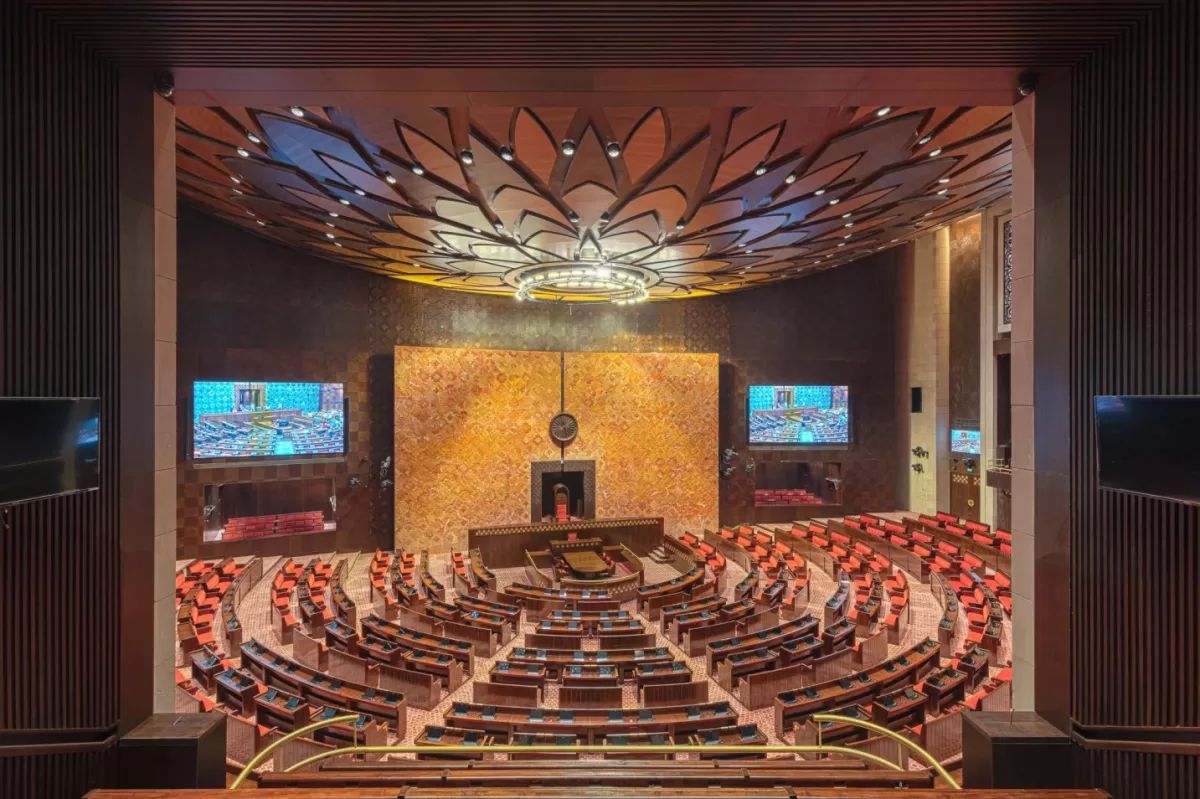
(Top Photo: Rajya Sabha Chamber in the new parliamentary building)