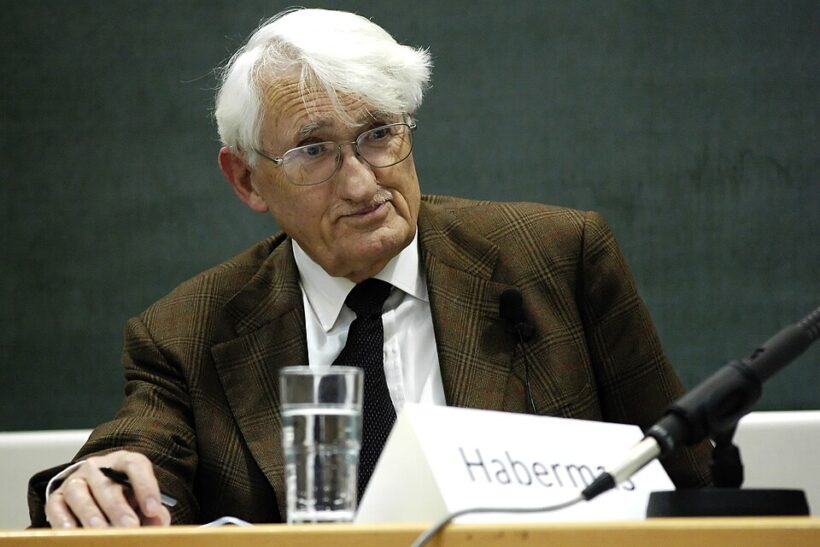
237. The man who shaped post-war German discourse is no more
Jurgen Habermas, the German philosopher and social theorist renowned for shaping post-war German discourse, passed away at the age of 96 in Starnberg, Germany, a week ago.
I learned about his philosophy after reading an article in which he examined the public role of religion in secular societies, as well as a widely discussed 2004 dialogue with Pope Benedict XVI.
Later, I bought a remarkable book titled “Autonomy and Solidarity: Interviews With Jurgen Habermas” by Peter Dews. In these extensive interviews, Habermas narrates his intellectual and political journey and shares his perspectives on modern social theory and social movements.
Peter Dews’s introduction was insightful for understanding the philosopher, as it discusses the current state and future of Critical Theory amidst recent revolutionary changes in Europe.
The interviews span from 1977 to 1990, a period during which he developed his main theories: communicative action and discourse ethics. He also discusses political and social events happening in Germany and Europe at the time.
In those days, Germany was debating how history should be viewed, with attempts to treat the Nazi past as one of many atrocities. Habermas opposed this view, advocating a nuanced approach that recognizes and preserves these memories rather than avoiding or minimizing them. This approach emphasizes acknowledging the ongoing consequences of past horrors and respecting the experiences of victims and their descendants.
His ideas made me realize why there was never an attempt in India to understand the horrors of partition and other tragic events in history. That could have shaped our minds to genuinely grasp democracy, its importance, and how to behave and function in a democratic country. But then, did India have such a philosopher in the last two centuries as Jurgen Habermas?
Habermas expressed concerns that the war in Ukraine would cause Europe to gamble away the last remnants of its geopolitical credibility.
Over more than seventy years, Jurgen’s public actions—ranging from sharp critiques of fascist ideas in the 1950s to recent warnings about rising militarism and nationalism in Germany—have influenced the country's course during critical moments.
Although support for his ideas has declined, as evidenced by the far-right Alternative for Germany (AfD) now being the second-largest party in parliament.
I believe you can only be a convincing critic of any ideology if you've been part of it in some way. In his case, his father was a passive sympathiser, and he himself joined the Hitler Youth, as did the vast majority of German boys.
At 15, as the war was drawing to a close, he managed to avoid being drafted into the Wehrmacht by hiding from military police.
In 1986, Habermas sparked a debate about the Holocaust after historians like Ernst Nolte argued that Nazi crimes were not entirely unique and could be understood within the broader context of European war and violence. Defending the uniqueness of Third Reich atrocities, Habermas believed that "Vergangenheitsbewältigung," or coming to terms with the past, had to be a central part of the country's identity.
Habermas also advocated, but failed, for European integration.
I especially appreciated his views on religion. He believed religion was a meaningful and potentially kind influence in modern society. He said, “Religion is still essential in daily life for normalizing interactions with the extraordinary.” When asked about his personal beliefs, he replied: "Religiously speaking, I am quite unmusical."
Throughout his life, he has engaged in many public debates on various topics. These include the reintegration of Nazi academics into West German society, the shortcomings of communism, student protests, terrorism both as a strategy and a justification for reactionary measures, the use of historical memory as a cover-up, the formation of the European Union, and the principles of constitutional democracy.
His major works include The Structural Transformation of the Public Sphere, which examines the development and decline of bourgeois public discourse, and The Theory of Communicative Action.
Philipp Felsch has written his biography titled The Philosopher, but that’s not available here.