199. The story of Bangladesh
I hate to see people going gaga over the victory of a man who returns home after 17 years in exile to become his country’s prime minister.
I am worried about people from Bangladesh. I am concerned and feel pity that they had no option but to choose a thief over dacoits.
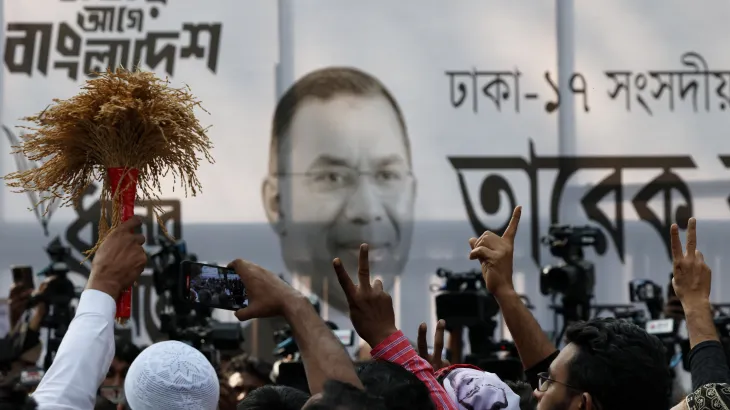
Tarique Rahman, from a dynastic family akin to the Nehru-Gandhi family, has pledged to end entrenched corruption and set the country on a new path.
He is promising a new era of clean politics. The word "clean" must be really embarrassed.
His family's party, the Bangladesh Nationalist Party (BNP), secured enough seats to make him prime minister for two reasons: first, the major political party was barred from participating in elections; and second, Hindus wanted to prevent the Jamaat-e-Islami from winning power. So, whether they liked it or not, they were forced to vote BNP.
Tarique Rahman comes from one of Bangladesh’s most powerful political dynasties; he is the son of former prime minister Khaleda Zia and former president Ziaur Rahman, who was assassinated in 1981.
During the BNP-led government from 2001 to 2006, the 2004 Dhaka grenade attack took place at an Awami League rally. The attack aimed at senior party leaders, including then-opposition leader Sheikh Hasina, resulting in 24 deaths and injuring hundreds. Rahman was convicted and sentenced to life in prison. However, in 2024, an appellate court reversed the verdict and acquitted him on the grounds of procedural irregularities in the original trial.
The reason is important to know: “due to procedural irregularities in the original trial.” With the help of the state apparatus, this attack was an attempt to make the Awami League leaderless.
During the 2001–2006 period when the Four-Party Alliance government was in power, Rahman faced frequent accusations from political rivals of engaging in widespread corruption within the power sector. The core of these claims centered on the so-called "Khamba" (electric pole) controversy.
Critics asserted that Rahman and his business partners exploited government offices to sway the awarding of government contracts, resulting in the procurement of thousands of electric poles at inflated prices.
Many of these poles were installed in rural areas, but not connected to a working electrical grid. These empty poles were tangible signs of systemic corruption and poor management.
In a January 2026 article titled "Bangladesh’s Prodigal Son," Time magazine noted that Rahman is still called "Khamba Tarique" by his opponents. The article also referenced a 2008 U.S. Embassy cable, leaked via WikiLeaks, which described Rahman as a "symbol of kleptocratic government" in Bangladesh.
Rahman has repeatedly denied these accusations, describing them as a smear campaign driven by political opponents and state intelligence agencies aimed at weakening the leadership of the Bangladesh Nationalist Party (BNP).
He allegedly ran a parallel power center during Zia's tenure, laundering money abroad.
In July 2016, Rahman was found guilty by the High Court of Bangladesh. Regarding the observation of the verdict, the High Court commented:
“Corruption practices and political influence are enabling individuals or groups to commit financial crimes like money laundering. It is time to stop such crimes under the political umbrella for the welfare and development of the country.”
The court sentenced Rahman to nine years in prison and imposed a Tk 30 million fine. His wife, Zubaida, received a three-year sentence and a Tk 3.5 million fine. Additionally, Rahman's illegal assets, valued at approximately Tk 3.5 million, were ordered confiscated and transferred to the state.
The Zia Charitable Trust corruption case involves Rahman, his mother, and others. The Anti-Corruption Commission claims that approximately Tk 2.1 crore in foreign grants received in 2004 by the Zia Orphanage Trust was misused for personal expenses rather than for the trust's activities. The case specifically accuses Rahman and his mother, former Prime Minister Khaleda Zia, of personally embezzling the foreign aid.
The case trial started in 2011. In 2018, a special court sentenced Zia to 5 years in prison, while Rahman and the other accused received 10-year sentences.
A case was registered in 2004 when authorities seized a large stash of arms and ammunition from 10 trucks in Chittagong. Rahman was charged with involvement in the alleged collection of these items for use in gunfights during the BNP government.
In 2014, Rahman spoke about Sheikh Mujibur Rahman at an event in London. A case was filed accusing Rahman of sedition over his comments about Mujib.
He was also reportedly engaged in publishing false and fabricated information, which jeopardized the country's sovereignty and included spreading hatred against the government.
The list is long. Corruption cases anywhere in the world are not registered if there is no corruption. Calling it a political vendetta is wrong.
Not to forget that Rahman is the son of a dictator, an army man who forcibly took over Bangladesh. Later, the uneducated and choiceless citizens gave it legitimacy by choosing his mother and then him.
However, democracy is not defined by this.
I am indifferent to what is happening in Bangladesh now.