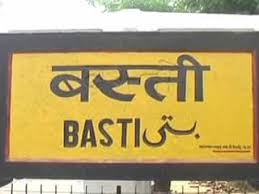
282. Basti: The mirror in a betel nut shop at a village fair
The mirror in a paan shop at a village fair
so dusty that no reflection is visible anymore.
(Basti/ gaanv ke mele mein kisee/ panvaadee kee dukaan ka sheesha/ jis par itanee dhool jam gaee hai ki/ ab koyee bhee aks dikhaee nahin deta.)
This is an excerpt from a poem by the renowned Hindi poet Sarveshwar Dayal Saxena.
Bhiura is a village in Basti district, and it has been 32 years since I left. When I visited recently, I saw two or three dogs outside the village. They barked and charged toward me. This wasn't a new experience, but it was the first time I'd encountered one in my own village.
I remember that when I first came to the city, the village dogs accompanied me up to the village border. Even after everyone else stopped and I walked alone with my bag, several dogs still followed me for a long distance and, when chased away, returned to the village with difficulty.
I don't know whether the dogs in all the villages across the country have been neutered these days, or whether there has been a change in their breed in recent years. Well, ever since the new, captivating 1991 economic liberalization policy has been introduced in the country, it's hard to say when someone's character will be devalued, or how much someone will become expensive as the dollar.
But one thing is clear: no scientist has ever conducted experiments on the dogs in my village, nor have they altered their behavior as part of any global conspiracy. There is no generation gap issue because their practical lives are limited; they may have watched Doordarshan occasionally, but definitely not MTV.
Yes, most of the houses in my village have televisions, but the village itself is empty. Only the elderly remain, warming themselves by the fire in the cold, like creatures from a magical world. As soon as they reach adulthood, the children flee to the city, returning only once or twice a year. Most of those who have televisions cannot see, and those who can see are deaf.
Those who stay alert often watch TV late into the night at Mithila Devi's house, the village head. She became village head after being elected as the Gram Pradhan, or should I say Gram Pradhanin, exemplifying women's reservation and Panchayat Suraj.
She just puts her thumbprint and sometimes goes to the district headquarters with her husband, groping her way under a veil of one and a half feet. Her husband, being Mumbai-born, is considered smart and introduces the young men on the threshold of youth to the thrill of changing trains at Bhusawal Junction.
In the early morning, I saw no dogs chasing the bulls as they headed to the farms. Moreover, there were very few bulls left. The sun rose on time and set in the evening without any disturbance. The village remained bleak. In the evenings, the village wasn't shrouded in smoke, and the aroma of oil and spices didn't waft from anywhere.
One day, when I went out to the fields with my father, the dogs kept barking in protest when they saw me. I recalled that earlier, they even recognized our relatives. Not only that, but they also kept an eye on people from the surrounding villages and had a mental note of who visited whose homes. At that time, a dog barking at night was considered a big deal.
My father had woken me up several times and said, "Look, the dogs are barking. It's possible some thief or robber has entered the village." Their barking would unite the entire village, and people would cough to mark their attendance.
My father told me that these dogs accompany every person leaving the village to the train station. Thefts have also begun in the village. But the dogs only bark at night when they hear the train whistle. Otherwise, they remain silent throughout the night.
Even the most recent theory, like postmodernism, failed to help me find a link between trains and dogs. Neither could the villagers my age, who appeared ten years older due to their regular beedi smoking, provide any insight.
I remembered a poem by Faiz Ahmad Faiz: “These stray, useless dogs of the streets/ These who are kicked by everyone/ These who die of hunger." But such a situation is unlikely to arise in the village, as the dogs there are neither stray nor useless. There's no hope they'll even wag their tails while they sleep.
(ye galiyon ke aavaara bekaar kutte/ ye har ek kee thokaren khaane vale/ ye phaakon se ukata ke mar jaane vaale.)
During election seasons, after five years, jeeps from various political parties would arrive in the village, and the dogs would chase them. My father explained that because the jeeps had been arriving every year, the dogs no longer paid them any attention. However, five days later, when I was heading back to the city, the village dogs followed my father to the border of the village to see me off.
They walked quietly behind us. I was taken aback by how their attitude had changed. Even after my father turned around, wiped his eyes, and asked me to come back soon, the village dogs continued to run ahead of me until we reached the railway station.
This excerpt from Sarveshwar's poem brought me relief at that moment. "Delhi/ A paper box/ With a fake diamond ring/ Wrapped in a cash memo of the real price."
(dillee/ kaagaj kee ek dibiya/ jismen naklee heere kee angoothee/
aslee daam ke kaishmemo mein lipatee huee rakhee hai)
I felt reassured that, despite errors in the cash memo, we still have real diamond rings in our village.
(Translated from "Phir Bhi," a collection of Hindi articles by Krishna Kumar Mishra on society, politics, cinema, and literature spanning the past three decades.)