298. Oslo, Press Freedom Index & Editor’s Guild of India
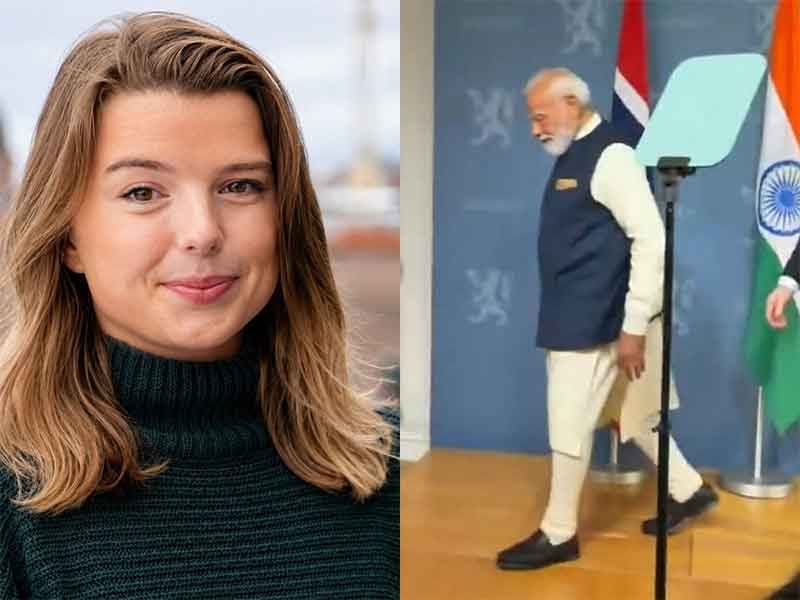
I wanted to dismiss this minor incident, which was intentionally staged by a wannabe journalist in Oslo seeking the limelight during Prime Minister Narendra Modi’s visit.
The incident received no coverage in European media, but back home in India, the journalist received strong backing from a few unwise, uneducated, and unfit politicians, including Mahua Moitra, the TMC MP, as well as some American-funded news websites based in the country. One of them even interviewed her as if she were a celebrity.
However, since the Editors Guild of India has entered the fray, it is time to give them a logical reply. The Guild described the incident as “embarrassing,” referring to exchanges between Indian officials and the journalist.
The Guild says it was concerned about the “stand-offs,” which were “triggered by the prime minister’s refusal to answer questions from local journalists following a press briefing.” The Guild must check its facts – it wasn’t a press briefing but the usual event where individual prime ministers make statements at the end of a bilateral talk.
Editors Guild of India’s statement reads: “It was regrettable that Modi has not held any open press conferences during his 12-year tenure as prime minister. The same intolerance toward questioning is increasingly evident at both the Union and state government levels…. Although Western journalists might not fully understand India’s history or the role of the Indian press during the freedom movement, they were right that journalists should ask questions in a democracy. Media restrictions hurt our economy and our society.”
The Guild has urged the Union government not to treat the media as an adversary. But it has forgotten that the head of the government is Narendra Modi, who has been the media's punching bag for almost a quarter of a century. The media has been an adversary, and has done immense harm to the country while taking Narendra Modi to task.
By issuing the statement, the Editors Guild is not only supporting the Oslo journalist but also, through her, subtly conveying a message to the world about the Indian prime minister’s refusal to hold press conferences.
Here's a brief overview of the widely discussed incident.
Prime Minister Narendra Modi was on a two-day official visit to Oslo. As he was leaving the podium after he and his Norwegian counterpart had addressed a joint press meet, Svendsen asked him: “Prime Minister Modi, why don’t you take some questions from the freest press in the world?” Again, remember it wasn’t a press conference.
So, in the first place, the cheeky girl chose the wrong platform to ask a question. After Modi departed without acknowledging Svendsen’s query, the journalist had said on social media that she had not actually expected the Indian prime minister to take her question.
Shortly after this, the Indian embassy in Norway organized a press conference, and again during the event, Svendsen asked: “Why should Oslo trust New Delhi?” She also asked if it could be promised that “human rights violations that go on in your country” would be stopped, and “will the prime minister start taking critical questions from the Indian press at some point in the future?”
A novice journalist from a country with a population of just around 56 lakh, where 70% follow Christianity, 27% follow no religion, and just 3.4% are Muslims, wanted Modi to assure her that once he returned to Delhi, he would make sure there wouldn't be any human rights violations and that he would address a press conference.
Only activists ask questions like this; journalists never do such a stupid act, and her question crossed the line between journalism and activism.
Her intention was to insult the Indian Prime Minister, and she herself said: “My only intention is to try to challenge the powerful people of this world, including PM Modi.”
Later, the Indian embassy in Norway tagged her directly on X, inviting her to a press conference organized by the Ministry of External Affairs. She attended and again questioned MEA officials about human rights violations in India and inquired when Modi would face tough questions from the Indian press.
She claims herself to be a “confrontational journalist” and says, “You have to try to interrupt. You have to try to get more answers. And the answers that you are looking for.” She said her questions on alleged human rights violations in India were based on what she called "trusted sources", such as Amnesty International and Human Rights Watch. Both have been propagating against India since 2014.
Read Human Rights Watch observation: “The Indian government, led by the Hindu nationalist Bharatiya Janata Party, has escalated its crackdown on civil society and the media. Authorities have routinely imposed internet shutdowns and prosecuted activists, journalists, and peaceful protesters on fabricated counterterrorism and hate speech laws. They have stifled rights groups using foreign funding regulations or unfounded allegations of financial irregularities. The government has adopted laws and policies that discriminate against religious minorities, especially Muslims.”
Amnesty International India now conducts its activities remotely due to the suspension of its local operations in September 2020. The organization had to cease its domestic work after the Enforcement Directorate froze its bank accounts over alleged breaches of foreign funding regulations.
Indian diplomat Sibi George put it well, saying, “People have no understanding of the scale of India. They read one or two reports published by some God-forsaken, ignorant NGOs and then come and ask questions. Don't worry about it. We are proud to be a democracy; we have been a democratic society for centuries.”
The journalist was under the intoxicating spell of Norway being ranked first on Reporters Without Borders’ global Press Freedom Index, while India ranks 157th out of 180 countries, simply because its unreasonable methodology is outrageous and ridiculous. It forgets that with a population of 140 billion and a multicultural society, India cannot be gauged on the same scale as Norway.
This “157th out of 180 countries” statement is also repeated every other day by some Indian media outlets whose sole job is Modi-bashing, including websites that are heavily funded by the American Deep State and the Congress Party.
But the clever operators of the website proclaim it to be “a joint venture in the public sphere between journalists, readers, and a concerned citizenry. This means relying principally on contributions from readers and concerned citizens who have no interest other than to sustain a space for quality journalism.”
I regularly read The Washington Post, The New York Times, The Guardian, and the English edition of Le Monde. I am surprised to see that they cover Bangladesh, Sri Lanka, and Pakistan extensively, yet we hardly find any news from India, except for some opinion pieces by Indians whose credentials we all know.
I fully endorse Narendra Modi’s decision to ignore the media. He should. In fact, when he became prime minister, the media split into two groups. One group shifted its loyalty and has been trying to erase the false and unsubstantiated impressions it had created in its readers' minds from 2000 to 2013, becoming highly sycophantic.
The other segment is barely existent, with only a few individuals running their own foreign-funded websites from the comfort of their cozy homes, constantly searching for ways to criticize Modi. Their main job is to make something out of nothing, which no one reads except for some hardcore BJP bashers. But they are happy to satisfy their masters, who feed them well. And they are part of the invisible American deep state.
Let us try to read Narendra Modi’s psyche. During my time with the Indian Express group, I wasn’t a fan of Modi, even though I recognized his significant efforts to strengthen his party in Haryana and Himachal Pradesh. At gatherings in Chandigarh, I found him quite shy.
Some dates are important. An earthquake struck India on January 26, 2001, killing at least 20,023 people, injuring another 166,000, and destroying about 400,000 buildings in Gujarat.
Most deaths and damage occurred in the Kutch district. I also lost close friends in Jamnagar, where we lived during 1985-87. After things had settled, I visited Jamnagar again and noticed that Keshubhai Patel's government was managing the situation poorly, with widespread corruption.
Narendra Modi became the Chief Minister of Gujarat on October 7, 2001, almost eight months after the earthquake, and the situation began to improve. Everyone praised him. I stayed there with my wife for a week, meeting friends and experiencing firsthand how such a tragedy should be handled. “The energy is coming directly from CM’s office,” a friend who had lost 7 members of his family, and all hope told me.
On the morning of 27 February 2002, five months after Modi came to power, the Godhra train tragedy occurred on the Sabarmati Express, killing 59 Hindu pilgrims and karsevaks returning from Ayodhya. When a riot subsequently broke out, it was widely reported as part of a broader pattern of ethnic cleansing, largely premeditated and possibly aided or supported by the state government. The media forgot all about Godhra and focused on the riots.
The Guild should recall how it misrepresented Narendra Modi’s straightforward comment and transformed it into something different. Modi had explained in an interview, when questioned about the 2002 riots deaths: “Even if I am in the back seat of a car and a puppy (kutte ka bachcha) gets under the wheels, isn't it painful? It is. Whether I am a chief minister or not, I am a human being. I will feel sad if something bad happens anywhere.”
What it implied was that anyone might feel upset, even if a puppy were hit by a car. The media distorted the comment to please the Congress Party, claiming, “Modi compared a community to dogs, which is very sad, humiliating, and disturbing. He suggests Muslims are worse than puppies.” This misrepresentation contributed to the portrayal of Modi as a monster.
Now, the same media expect a press conference. But part of the truth also lies elsewhere. Their concern stems from ending the long-standing practice of allowing media representatives, including reporters, editors, and photojournalists from news outlets, to travel on the official VVIP aircraft. In the past, journalists flew on the same plane as the Prime Minister, but this practice was discontinued in 2014 when Modi's government changed the policy.
The media's role is to communicate the government's message to the public, a task that alternative platforms like Twitter are doing effectively. So, why should Modi encounter journalists who hold their own biases?