176. The Butcher of Hama has died
Just as you feel happiness when your favorites, whether encountered or not, remain alive and healthy, you also experience joy when you learn that those you disliked have passed away.
Today is truly one of those days.
Rifaat al-Assad, the uncle of the former Syrian leader Bashar al-Assad and infamous as the “Butcher of Hama” for his role in suppressing a 1980s uprising, has died at age 88.
Once a key figure in the Assad family’s dynastic control, Rifaat relocated to the United Arab Emirates after rebels overthrew his nephew’s government in December 2024.
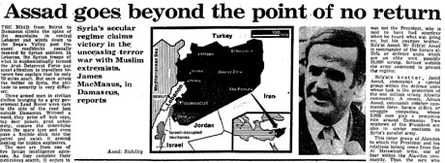
In February 1982, the Hama massacre took place when the Syrian Arab Army and the Defense Companies paramilitary force, following President Hafez al-Assad's orders, besieged Hama for 27 days to suppress an uprising by the Muslim Brotherhood against the Ba'athist government.
Rifaat’s role in the massacre earned him the nickname ‘the Butcher of Hama’ because he led the elite Defense Brigades. The death toll after 27 days of violence was estimated at 40,000.
The massacre remains the single deadliest act of violence committed by an Arab state against its own people.
Before beginning operations, Hafez al-Assad ordered the sealing of Hama from external contact, resulting in a media blackout, complete shutdown of communications, electricity, and food supplies to the city for several months.
A report in The Globe and Mail described the operation as a two-week orgy of killing, destruction, and looting that devastated the city and resulted in at least 25,000 deaths.
The Hama massacre once again made headlines when Ba'athist government forces were expelled after successful rebel offensives in December 2024, which ultimately ended the Assad family's rule in Syria.
The Ba'ath Party of Syria, which promotes Ba'athism along with Arab nationalism and Arab socialism, came into conflict with the Muslim Brotherhood, a group supporting Sunni Islamist ideology. Thus, the two groups were fundamentally opposed.
The Ba'ath Party was officially secular and nationalist. In contrast, the Muslim Brotherhood and other Islamist groups regarded nationalism as un-Islamic, believing that religion is inherently linked to politics and governance.
Most Ba'ath Party members came from humble, obscure backgrounds and favored radical economic policies, while Sunni Muslims tended to view government intervention as threatening their interests. Although not all Sunni notables believed in fundamentalism.
Hama was known as a stronghold of Islamic conservatism and the Muslim Brotherhood. The initial full-scale conflict between them happened soon after the 1963 coup, which marked the Ba'ath party's first rise to power in Syria.
The Hama massacre has come to symbolize both the human rights abuses and the brutal repression carried out by the al-Assad government.
The memory remains a significant part of Syrian culture and continues to evoke a deep sense of resentment among Syrians to this day.
This is not about deciding who was right or wrong — technically, the Ba'ath Party's actions could have been justified - but what about the violation of human rights, specifically the fundamental right to live peacefully on Earth?