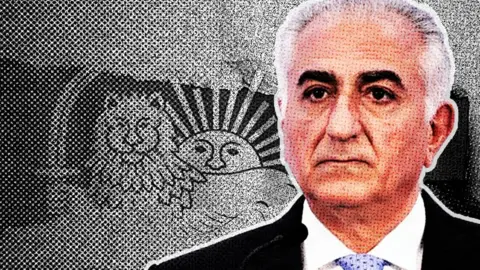
214. The US is ready with a prince to rule Iran
The indications clearly show that after successfully installing a Prince in Bangladesh, the U.S. has now shifted its focus to Iran, where a Prince is already waiting.
Iran’s monarchy has deep historical roots, but the Pahlavi dynasty—the last to rule—began in 1925 when Reza Khan, a military officer, overthrew the previous dynasty.
Reza Khan adopted the name Pahlavi, aiming to modernize Iran by aligning it more closely with Western social and economic norms. He was ultimately exiled by the British following the Anglo-Soviet invasion of Iran in 1941.
His son, Mohammad Reza Pahlavi, sought to continue his father’s reforms but also adopted an authoritarian stance. He was ultimately overthrown by widespread opposition during the Islamic Revolution of 1979.
Currently, Reza Pahlavi, the 65-year-old exiled crown prince, is increasingly seen by many, especially in the diaspora, as the most credible and prominent opposition leader capable of leading the country. Royalist supporters remain optimistic, fueled by chants of “long live the shah” during recent protests.
However, if we look at the chain of events over the last 12 months, the mystery slowly unfolds about why a sudden protest erupted and about the US's role after Trump arrived in the Oval Office. The attack we saw two days ago wasn’t sudden.
Last June, the U.S.-based organization National Union for Democracy in Iran, a prominent supporter of Pahlavi, unveiled a detailed long-term plan called the "Iran Prosperity Project,” which serves as its strategy for Iran's economic rebuilding. Pahlavi himself authored the foreword. The group also released its “Emergency Phase Booklet," which presents a vision for a new political system in Iran during the transition period.
The document grants the crown prince extensive authority, describes him as the “leader of the national uprising,” and endows him with the power to veto institutions and decisions within a transitional government.
Under the plan, the government would remain highly centralized under Pahlavi's leadership until a referendum, which the report says would decide whether to transition to a constitutional monarchy or a democratic republic.
Note that groundwork began as early as 2024, when a poll by the GAMAAN group, founded by two Iranian academics based in the Netherlands, sought to gauge political opinions in Iran. A little more than 30% of respondents said Pahlavi would be their top candidate. This result must have encouraged the Trump administration to start its game.
Although anti-regime protesters have helped facilitate regime change despite a severe government crackdown that caused over 20,000 deaths, Trump should be reminded that during the recent protests, some students were also heard shouting, “No to monarchy, no to clerical leadership, yes to an egalitarian democracy."
The extent of support for the shah in Iran remains uncertain; however, do Iranians truly desire the shah's return, and would it serve the country's best interests?
The Islamic Republic is facing its deepest political crisis since its founding, due to attacks by Israel and the US, including the assassination of its supreme leader.
Living outside Iran for 45 years, the exiled Prince Reza Pahlavi, immediately following the killing of Supreme Leader Ayatollah Ali Khamenei, made a pitch to lead the Islamic Republic, saying he has the support of millions in Iran and that even the Iranian military will side with him.
In an interview with Fox News, Pahlavi said he has a plan of action and a transition plan. "Just by the change we hope to bring to the table, it will probably be worth over a trillion dollars in impact and revenue to the American economy, just by Iran’s market being opened to America and how much we stand to benefit from billions of dollars willing to be invested into Iran," he said.
Do we need any more proof of what Trump has planned? An open market and oil, which he is so obsessed with.
Iranians should recall that Ayatollah Ruhollah Khomeini promised a more democratic Iran with a new constitution, excluding himself and other clerics from leadership. Nonetheless, following the revolution, Khomeini swiftly consolidated power.
History will repeat itself if Shah is allowed to return using the politically maneuvered strategy the US has mastered, as previewed in Bangladesh.
The future of Iran is very unclear at the moment. If Iranians want to live peacefully, they must stop the Shah from returning and fight until their last breath against the Israel-US attack. Only then will democracy arrive in the country and last.
There is no easy way out.