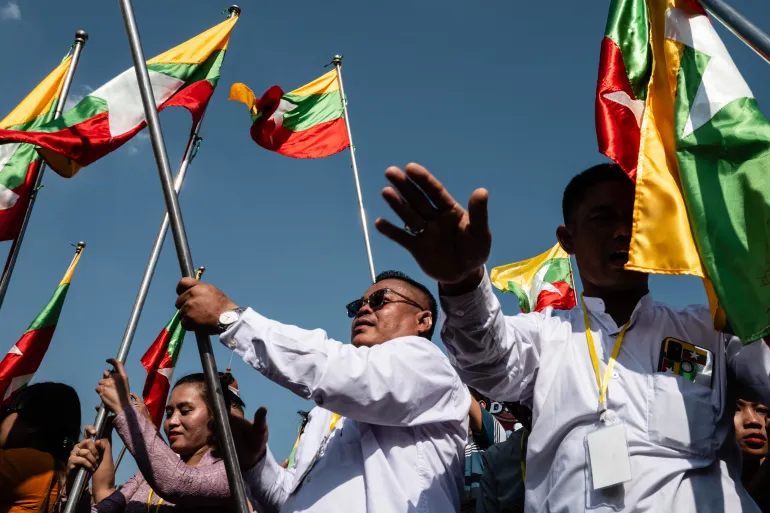
185. Myanmar gets what was anticipated
Myanmar's election results aligned with expectations, and its parliament is scheduled to meet in March to choose a president, with a new government expected to assume office in April.
The election was held four years after the military seized power in a coup that removed the democratically elected government of Nobel laureate Aung San Suu Kyi.
Since the coup, Myanmar has experienced ongoing political unrest, and the suppression of pro-democracy protests has sparked a nationwide rebellion. The United Nations reports that approximately 3.6 million people have been displaced.
Junta leader Min Aung Hlaing is expected to play a crucial role in the upcoming government. He has characterized the elections as a step toward stability and affirmed that power will be transferred to the elected representatives.
Voting occurred in 263 of Myanmar’s 330 townships, including regions not fully under junta control. Overall turnout was around 55% across all three phases.
Aung San Suu Kyi’s National League for Democracy was dissolved, along with dozens of other parties, while some chose not to participate.
As expected, the military-supported party achieved a clear victory in the three-phase general election. The process was carefully controlled despite ongoing civil war and widespread repression.
The Union and Solidarity Party (USDP) consistently led throughout the election, capturing a large majority in both legislative chambers. It secured 232 out of 263 seats in the lower Hluttaw and 109 out of 157 seats in the upper Hluttaw.
Formed in 2010 after decades of military-influenced governance, the USDP was intended to serve as a military proxy. The party is headed by a retired brigadier general and includes numerous other former senior officers. In the election, it fielded 1,018 candidates, accounting for 20% of all registered candidates.
Ironically, in Myanmar’s political system, the military automatically holds 25% of parliamentary seats, ensuring it retains influence even after transferring power to a civilian government.
But was it truly an election? The 11-member Association of Southeast Asian Nations rightly declared it will not support the process, and some Western countries have also refrained from endorsing it.
India's perspective remains unclear at this time.