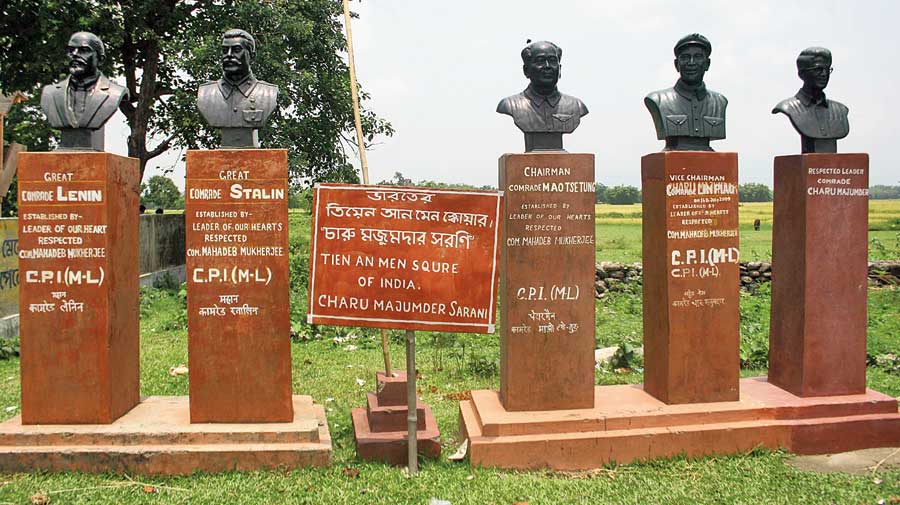
116. Postcards from Naxalbari (March 11-April 19, 1981)
The word Naxal doesn’t need any explanation. In fact, there is a small single-platform railway station in the Darjeeling district in West Bengal, named Naxalbari. The Naxalbari town is just 4 kilometers away from the railway station. And that’s the origin of the word Naxal.
On May 25, 1967, an armed peasant uprising occurred in the Naxalbari block, marking a significant event that fueled the growth of a new ideology. The tea garden workers in the Darjeeling region joined strikes in support of the peasants.
Primarily driven by tribal groups and radical communist leaders from Bengal, the armed struggle resulted in Naxalism and ignited the Naxalite–Maoist insurgency. This movement rapidly expanded from West Bengal into Maharashtra, Andhra Pradesh, and other areas, and continues to this day.
The world during that time was a difficult place to live, marked by numerous events. People experienced frustration, and their anger reached a peak.
In that context, Charu Majumdar, the ideologue of the uprising, believed the conditions were favorable for initiating an armed People's War in India, following the Chinese Communist Revolution, Vietnam War, and Cuban Revolution.
He authored the Historic Eight Documents, laying the foundation for the Naxalite movement in 1967.
In the region, that offered the ideal starting point for the movement, you are either a jotedar with extensive farmland or someone who owns neither a home nor land and relies entirely on the jotedars.
Life is tough there as it was years back.
The uprising was harshly suppressed, and as a response to the uprising, the police opened fire, killing nine women and one child. Leaders were detained, and some, like Charu Majumdar, went underground.
Going back to understand the genesis, the seed originated from worsening relations between CPI (M) and the Chinese Communist Party (CCP).
The CPI (M) was more aligned with Russia than China. As usual, China wanted to destabilize India and openly supported the disgruntled group from the CPI (M).
Several CPI(M) members who supported the uprising were expelled and later organized into a single group, the All-India Coordination Committee of Communist Revolutionaries, which later became the CPI(ML).
The Naxalite movement drew a large number of young people. Students affiliated with both the Communist Party were natural supporters of the uprising.
However, when the news spread through the newspaper pages about the brutal way the government crushed the uprising, it changed minds.
The supporters understood that India is different from China and Cuba. Moreover, Indians have historically not been prone to armed rebellion. It is a land associated with Buddha.
People value peace above all, which is why Yoga originated in India rather than Europe. Yoga focuses on stillness, serenity, and compassion. So, such a movement will never find supporters.
Meanwhile, politics heavily influenced the movement, causing it to be hijacked and lose its core purpose.
However, to highlight an important fact, the younger generation, observing an ineffective government at both the central and state levels, became frustrated, and the nation’s mood reached a high pitch, which democratically was expressed only when Jaiprakash Narayan and George Fernandes prominently entered the political scene.
A keen observation and objective analysis will clearly connect both events.
It just so happened that I was stationed in Jalpaiguri, and every time I traveled by train, I would pass through Naxalbari railway station, which always piqued my curiosity.
One day, I visited a small town near Hasimara called Hamiltonganj, which had the only theater in the area.
The film Junoon (The Obsession), based on Ruskin Bond’s novella, A Flight of Pigeons, was running in the theatre.
It is a wonderful love story in the volatile backdrop of the Indian Rebellion of 1857, produced by Shashi Kapoor and directed by Shyam Benegal.
After buying the ticket, as I turned away from the ticket window, a disheveled man in his forties with dirty clothes tapped my shoulder. He asked for five rupees.
His pleasant manner, the way he spoke in a mix of Bengali, English, and Hindi, attracted my attention. He definitely was not a typical beggar.
The kind of knowledge he flaunted made me leave the picture and spend the two hours with him at a nearby tea stall, where he finished two packets of biscuits with numerous cups of hot tea.
It was a masterful exploration of the philosophy behind inequality, hunger, suppression, police atrocities, and a bleak outlook for the future.
And yes, he narrated why did the Naxalbari movement suddenly erupt like lava?
Additionally, why it subsidized at the same rate in its original area but expanded into other regions?
I decided to explore it more deeply, and with his help, I spent 40 days in and around the place that has become a part of history.
I met hundreds of people, listened to their plight, and one thing was clear – the people had no understanding of this Naxalite theory, in a political and ideological sense.
To them, it was a rebellion against the atrocities of jotedars. Nothing more.
There was no China factor, and the historic Eight Documents authored by Charu Majumdar had no role.
But the police treatment was so frustrating that a new kind of anger was emerging—one that led to a culture in all of Bengal that still persists.
Previously, it was CPM that channeled this energy in its favor, and now the same is being done by Mamata Banerjee.
It was difficult for me to write a novel because of the language barrier, but poetry doesn't require language. It relies on emotions, primarily expressed through the eyes, facial expressions, and incomplete sentences.
So, I wrote many poems in both Hindi and English.
Although well-received upon publication, the book caused problems for my Hindi publisher.
When he submitted it to a government bulk purchase program for libraries, it was quickly rejected because it contained ‘some Naxalite poetry’.
I’m presenting here some of the poems from the series.
Just feel for the next eleven days what I felt during those 40 days.
1.
it's almost 14 years
now most of us are
happy in our unhappiness
most of us are
satisfied in our dissatisfaction
most of us have
now realized
human beings are
predominantly self-destructive
most of us
climbing the
wall of worry
now expect nothing
because we live
as if we would live forever
content with
the small pleasures
of life
(From my poetry collection, “Always in Transit”)